If you're planning the Manaslu Circuit from the United States, you're already taking on more than most trekkers on this route. You're not just booking a two-week hike — you're coordinating a 20+ hour journey across multiple time zones, working around a limited vacation window, and trusting an agency on the other side of the world to get your permits, guide, and logistics right before you've even left home. That makes the choice of guided tour operator one of the most important decisions in the entire trip, arguably more important than the itinerary itself.
Hand-picked itineraries
Recommended Trips
Related journeys you may want to explore after reading this article.
Why a Guided Tour Isn't Optional on Manaslu
Unlike more established routes such as Everest Base Camp or the Annapurna Circuit, the Manaslu region sits inside a government-designated restricted area close to the Tibet border. Nepal's Department of Immigration requires every foreign trekker on this route to be accompanied by a licensed guide from a registered trekking agency. There is no independent or self-guided version of this trek, and no way around it — agencies without proper registration and TAAN (Trekking Agencies' Association of Nepal) affiliation cannot even apply for your Restricted Area Permit (RAP) in the first place.
So for a US-based trekker, the real question isn't should I book a guided tour — it's which guided tour, and from which agency. That decision affects everything from your safety on Larkya La Pass to whether your permit paperwork is even valid.
What US Travelers Should Look for in a Manaslu Agency
Registration and permit authority. Confirm the operator is registered with the Nepal Tourism Board and holds current TAAN membership. This isn't a marketing detail — it's the legal mechanism that makes your RAP possible. If an agency is vague about this, that's a red flag worth taking seriously before you send any deposit.
Responsive, time-zone-aware communication. Kathmandu runs 10 to 13 hours ahead of the continental US depending on the season and coast. A same-day email response from Nepal often means someone is working outside normal hours to accommodate you. Agencies that are used to international, especially American, clients tend to build in evening or early-morning availability specifically for this reason. Test this before booking — send a detailed question and see how quickly and thoroughly it gets answered.
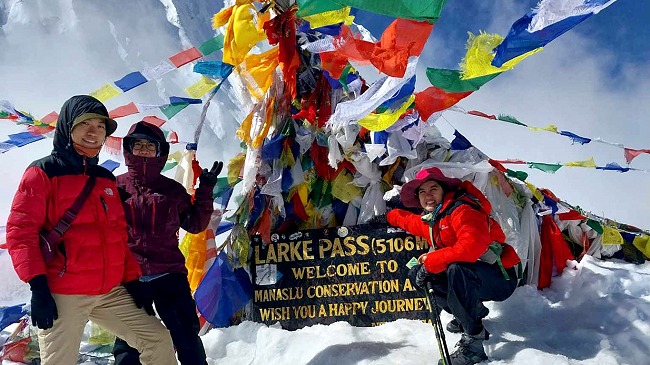
A guide who actually knows this specific route. Manaslu is not interchangeable with Everest or Annapurna. The trail through the Budhi Gandaki gorge is narrower and less developed, and Larkya La at 5,160 meters is a genuinely technical high-altitude crossing, often icy, with a long and physically demanding summit day. Ask how many times your assigned guide has led this particular circuit, not just how many years they've guided in Nepal generally.
Transparent, all-inclusive pricing. A trustworthy quote lists exactly what's covered: all three required permits (RAP, MCAP, ACAP), guide and porter fees, teahouse accommodation, airport transfers, and any Kathmandu hotel nights. Ask specifically what's excluded — travel insurance, personal gear, tips, and extra nights due to weather delays are common gaps that should be spelled out upfront, not discovered after you've landed.
Flexible or fixed departure dates that fit a US vacation window. Backpackers on open-ended trips can be loose about start dates. Most US trekkers can't. Look for an agency that offers both scheduled group departures and the option to arrange a private start date, so you can work backward from the actual days off you have.
Building the Trip Around US Travel Realities
A few planning details matter more when you're coming from the US than they would for a trekker already in the region:
- Build in buffer days. Long-haul flights into Kathmandu via Delhi, Doha, or similar hubs are prone to delays and missed connections. A single missed day can cascade into a missed trek start if your itinerary has zero slack. Add at least one buffer day before the trek begins and, ideally, one after, in case Larkya La is weather-closed and the group needs an extra day to cross safely.
- Sort out visas and vaccinations early. US citizens can get a visa on arrival in Kathmandu, but it's worth confirming current entry requirements and any recommended vaccinations with a travel clinic well before departure, since this isn't something a trekking agency manages for you.
- Train for altitude, not just distance. Most US trekkers live at low elevation, so the jump to a 5,160-meter pass is a bigger physiological adjustment than the mileage alone suggests. Cardio training in the months beforehand, plus a trek itinerary with proper acclimatization days, matters more here than raw hiking experience.
A Reliable Starting Point
Peace Nepal Treks has been organizing Himalayan treks for decades and runs its Manaslu Circuit Trek with both fixed-date group departures and private, date-flexible bookings — a practical option if you're working around a specific set of US vacation days rather than an open calendar. The agency handles Kathmandu-side logistics, including permit processing, hotel pickup, and pre-trek briefings, before you even land, which takes a meaningful amount of pressure off travelers coordinating everything from another continent.
Whichever agency you choose, treat the vetting process itself as part of your trip preparation. A responsive, transparent, properly registered operator will make the difference between a smooth Himalayan adventure and a stressful scramble to fix problems 8,000 miles from home.