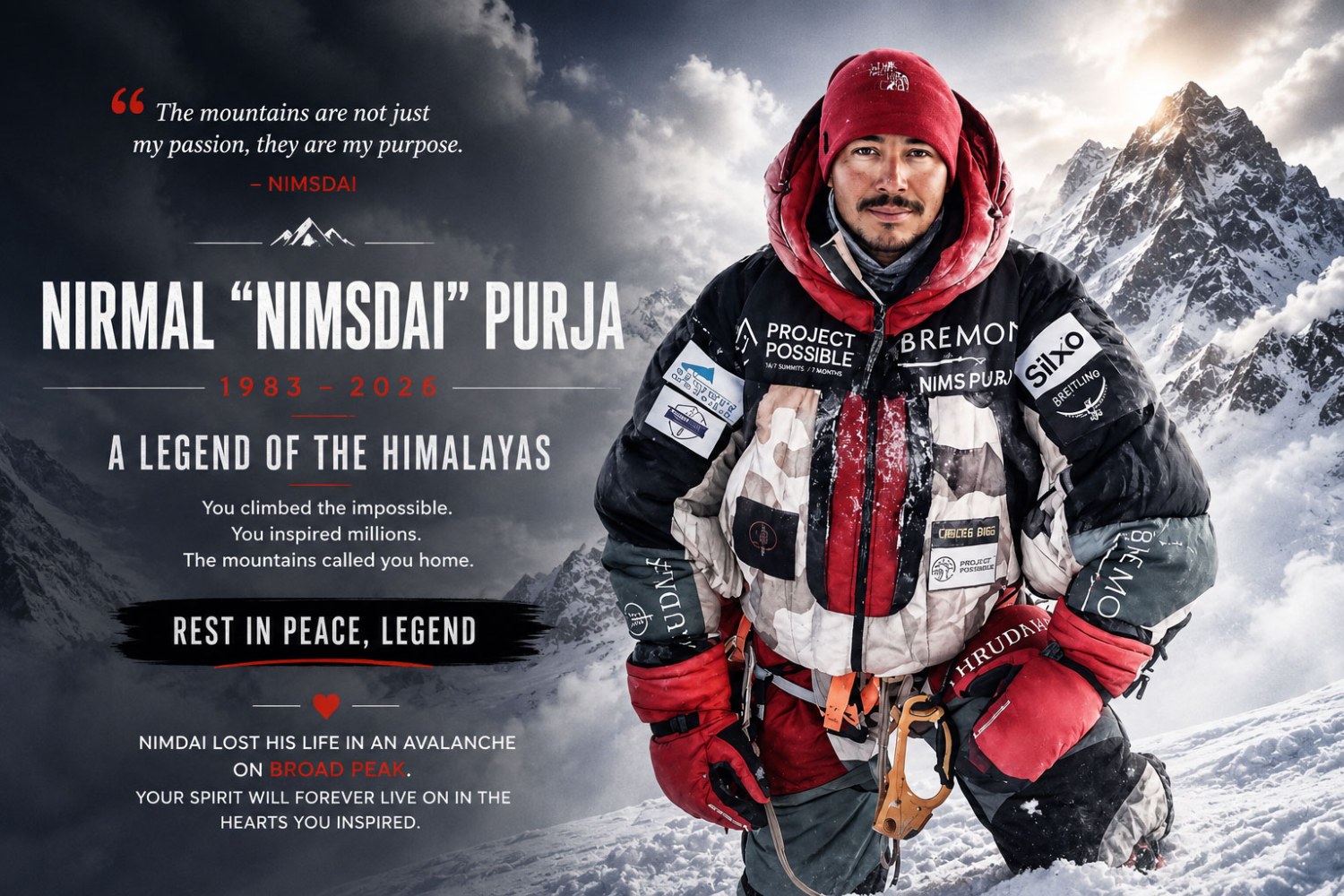
Nepal and the global mountaineering community are in mourning. Nirmal "Nimsdai" Purja MBE, the record-breaking climber who redefined what was thought possible in high-altitude mountaineering, has died in an avalanche on Broad Peak in Pakistan. He was 43.
His expedition company, Elite Exped, confirmed the news on August 1, 2026, following days of search efforts after an avalanche struck his 10-person team on Broad Peak's West Ridge route on July 30. Purja's trusted climbing partner and guide, Nima Sherpa, and several other members of the expedition also did not survive. As of the most recent reports, recovery operations in the difficult, high-altitude terrain of Pakistan's Gilgit-Baltistan region were still ongoing.
The loss has been felt deeply in Nepal, where Purja was widely regarded as the man who put Nepali climbers — long overshadowed as "support staff" on Western-led expeditions — at the center of the mountaineering world.
What Happened on Broad Peak
Purja was leading an international expedition on Broad Peak (8,051m), the world's 12th-highest mountain, located in the Karakoram range near K2. On July 30, 2026, an avalanche struck the group of 10 climbers on the mountain's standard route at an altitude between roughly 21,600 and 21,850 feet. The expedition included climbers and guides from Nepal, Oman, the United States, Pakistan, and China.
Pakistani mountaineering authorities and the Alpine Club of Pakistan led search and recovery efforts in the days that followed, hampered by harsh weather and the remoteness of the accident site. Elite Exped confirmed Purja's death in a statement expressing profound sadness and requesting privacy for the grieving families.
Who Was Nirmal Purja?
Nirmal Purja was born on 25 July 1983 in the Myagdi district of Nepal; his family later relocated to Chitwan. He grew up in modest circumstances and, following in his father's footsteps, set his sights on joining the British Army's famed Gurkha regiment — a dream he achieved in 2003.
Over a 16-year military career, Purja rose to become the first Gurkha ever selected for the UK Special Boat Service (SBS), one of Britain's most elite special forces units, serving in operations including Afghanistan. It was during a period of military leave in 2012 — a trek to Everest Base Camp — that his interest in high-altitude mountaineering began.
He summited Mount Everest for the first time in 2016, during a rescue mission that later earned him an MBE (Member of the Order of the British Empire). In 2017, he led an expedition of 13 fellow Gurkhas to Everest to mark 200 years of Gurkha service to the British Army, and set his first major mountaineering record by climbing Everest, Lhotse, and Makalu within five days.
Project Possible: The Record That Made Him a Global Icon
In 2019, Purja left the SBS to attempt what almost no one believed was achievable: climbing all 14 of the world's 8,000-metre peaks — the so-called "eight-thousanders" — in a single season. He called the expedition Project Possible.
He completed the challenge in six months and six days, shattering the previous record of nearly eight years set by Polish climber Jerzy Kukuczka in 1987. The feat turned Purja into one of the most recognized names in extreme sports worldwide, and the Netflix documentary "14 Peaks: Nothing Is Impossible" (2021) introduced his story to a mainstream global audience far beyond the climbing world.
His mountaineering resume also includes:
- The first winter ascent of K2 in January 2021, achieved alongside an all-Nepali team of ten climbers — a historic first for the "Savage Mountain," accomplished by Nepali climbers on their own terms
- Multiple Guinness World Records for speed ascents above 8,000 metres
- Numerous high-altitude rescues carried out during his own expeditions
His Contribution to Nepali Mountaineering and Tourism
Beyond the personal records, Nirmal Purja's greatest legacy may be what he did for how the world sees Nepali and Sherpa climbers. For decades, Nepali guides, porters, and high-altitude workers had powered nearly every major Himalayan expedition while receiving a fraction of the international recognition given to the foreign climbers they supported.
Purja changed that narrative:
- He proved Nepali-led expeditions could set world records on their own terms — most visibly with the all-Nepali winter ascent of K2, a summit that had defeated international teams for decades.
- He founded Elite Exped, a Nepali-owned and Nepali-led expedition company, demonstrating that world-class high-altitude operations didn't need to be run by foreign outfitters.
- He became a global ambassador for Nepal's mountains, drawing an enormous wave of international attention, media coverage, and — directly and indirectly — tourism interest in Nepal's trekking and climbing industry through Project Possible and the Netflix documentary that followed it.
- He inspired a new generation of Nepali climbers and guides to see high-altitude mountaineering as a path to recognition and record-setting achievement, not just a support role for others' ambitions.
- He pushed for Nepali climbers to be named and credited in expedition reporting, rather than left anonymous in the shadow of the clients they guided.
For Nepal's trekking and tourism industry, Purja's fame translated directly into curiosity about the Himalaya — trekkers and climbers who first heard his name through 14 Peaks often went on to research Everest Base Camp treks, Annapurna expeditions, and Nepal's other iconic routes for themselves.
Tributes From Around the World
Tributes poured in from across Nepal and the international mountaineering community following confirmation of his death. Nepal's Prime Minister, Balendra Shah, said the physical journey of the climbers had stopped, but that their courage and contributions would remain a lasting inspiration. UK Defence Minister Wes Streeting also paid tribute, recalling Purja's years of service in the British Armed Forces alongside his global mountaineering achievements.
A Message From the Peace Nepal Treks Team
The entire team at Peace Nepal Treks is heartbroken by the loss of Nirmal "Nimsdai" Purja.
As a Nepali trekking and expedition company, we owe Nims a debt that's hard to put into words. He didn't just climb mountains — he changed how the world sees Nepali climbers, guides, and porters, and by extension, how the world sees companies like ours. Every Nepali guide who has been recognized by name, every Nepali-led expedition that's been taken seriously on the world stage, and every trekker who came to Nepal after watching 14 Peaks carries a piece of what Nims built.
Our deepest condolences go out to his wife Suchi, his daughter Himani, his family, his climbing partners, and everyone at Elite Exped during this unimaginably difficult time. We also hold in our hearts the other climbers and guides — including Nima Sherpa and Pur Bahadur Gurung — who lost their lives alongside him on Broad Peak.
Nimsdai's motto was simple: nothing is impossible. Nepal's mountaineering community will carry that forward. Rest in peace, Nims — the mountains you loved will remember you.
— The Peace Nepal Treks Team
Frequently Asked Questions
How did Nirmal Purja die? Nirmal Purja died in an avalanche that struck his expedition team on Broad Peak (8,051m) in Pakistan's Gilgit-Baltistan region on July 30, 2026. His death was confirmed by his expedition company, Elite Exped, on August 1, 2026.
How old was Nirmal Purja when he died? Nirmal Purja was 43 years old. He was born on 25 July 1983 in Myagdi, Nepal.
What is Nirmal Purja best known for? He is best known for "Project Possible," his 2019 expedition in which he climbed all 14 of the world's 8,000-metre peaks in six months and six days, shattering the previous record by more than seven years. His story was told in the Netflix documentary "14 Peaks: Nothing Is Impossible."
What was Nirmal Purja's military background? Purja served 16 years in the British military, six of them with the Brigade of Gurkhas and the remainder with the UK Special Boat Service (SBS), where he became the first Gurkha ever selected for the unit.
What was Nirmal Purja's biggest contribution to Nepali mountaineering? Beyond his personal climbing records, Purja is widely credited with elevating the global recognition of Nepali and Sherpa climbers, proving that Nepali-led teams could achieve world-first records — most notably the first winter ascent of K2 in 2021 — and inspiring a new generation of Nepali mountaineers and guides.
Where is Broad Peak? Broad Peak is the world's 12th-highest mountain at 8,051 metres, located in the Karakoram range in Pakistan's Gilgit-Baltistan region, near K2.
Peace Nepal Treks offers guided treks and expeditions across Nepal's Himalaya, led by experienced local guides. If you'd like to honor Nirmal Purja's legacy by experiencing the mountains he loved, explore our Everest Base Camp and Manaslu Circuit trekking packages, or get in touch with our team to plan your own Himalayan journey.