
Because the Manaslu Circuit runs through a legally restricted area, booking this trek isn't quite as simple as picking an itinerary off a map and paying a deposit. The Nepal government requires every foreign trekker to travel with a licensed guide from a registered agency, which means the agency you choose isn't just a service provider — it's the entity that makes your trek legally possible in the first place. Here's how to work through that process properly, step by step.
Hand-picked itineraries
Recommended Trips
Related journeys you may want to explore after reading this article.
Step 1: Confirm the Agency Is Actually Registered
Before you look at itineraries or prices, confirm two things: that the operator is registered with the Nepal Tourism Board, and that it holds current membership with TAAN, the Trekking Agencies' Association of Nepal. This matters far more on Manaslu than on more open routes, because only properly registered agencies can apply for the Manaslu Restricted Area Permit (RAP) on your behalf. An operator that can't clearly confirm this — or is vague when asked directly — cannot legally get you onto the trail, no matter how good their website looks.
Don't be shy about asking directly. A reliable agency will have no hesitation confirming its registration details and will usually list them on their site or provide them immediately when asked.
Step 2: Read Reviews for Specifics, Not Just Star Ratings
A five-star average tells you very little on its own. What's more useful is looking for detailed, specific reviews — trekkers mentioning a guide by name, describing how a particular tough day was handled, or noting that they've booked with the same company more than once for different treks. Repeat customers are one of the strongest signals of reliability in this industry, since trekking is expensive and time-consuming enough that people generally don't return to an agency that let them down the first time.
Peace Nepal Treks, for example, has clients who've returned for multiple different treks across the years — the kind of long-term relationship that's harder to fake than a review left once and never followed up on.
Step 3: Request a Fully Itemized Quote
This is one of the most important steps, and one many trekkers skip. Ask for a breakdown that clearly separates:
- All three required permits — RAP, Manaslu Conservation Area Permit (MCAP), and Annapurna Conservation Area Permit (ACAP)
- Guide fees
- Porter fees (and whether a porter is included by default or optional)
- Teahouse accommodation for each night
- Meals during the trek (some packages include them, others don't)
- Airport transfers and any included Kathmandu hotel nights
- Ground transportation to and from the trailhead
Then ask explicitly what's not included. Common exclusions worth clarifying upfront are travel insurance, personal trekking gear, tips for your guide and porter, and any extra costs if bad weather forces additional nights on the mountain. A reliable agency will answer this without hedging.
Step 4: Ask About Your Specific Guide and Group Setup
Don't just confirm that a guide is included — ask who it will be, how many times they've led this specific Manaslu route (not just Nepal treks generally), and whether they speak English fluently enough for clear communication during a demanding pass crossing. Also clarify whether you'll be joining a small group of other trekkers or booking privately, since this affects both cost and pacing.
If you're traveling solo, ask directly about the current permit rules. Restricted-area regulations have required a minimum of two trekkers per RAP application in the past, though these rules have evolved in recent seasons. A trustworthy agency will explain the current requirement clearly and accurately rather than leaving it ambiguous or promising something it can't actually deliver.
Step 5: Understand the Payment Structure
A legitimate operator typically asks for a reasonable deposit to confirm your booking — not full payment upfront — with the balance due closer to departure or on arrival in Kathmandu. Be cautious of any agency pressuring you toward full advance payment with little documentation. Before sending any deposit, you should receive:
- A written day-by-day itinerary
- Clear terms covering cancellation, rescheduling, and refund policy
- Confirmation of what documents they need from you (passport copy, passport-style photos) to begin permit processing
Step 6: Ask How They Handle Weather Contingencies
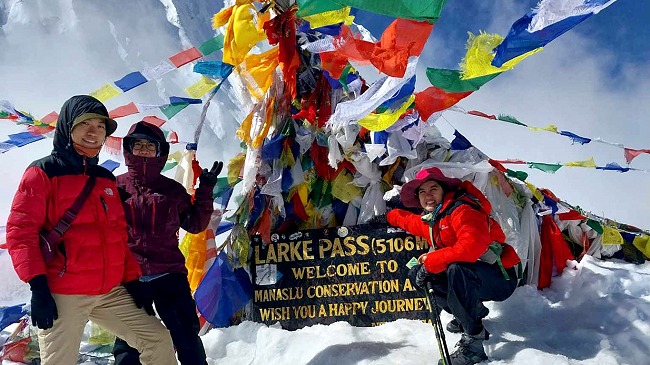
Larkya La Pass can be weather-closed for a day or more during the trekking season, and this is one of the most common reasons itineraries need adjusting mid-trek. Ask your agency directly: does the itinerary already include a buffer day, and what's the plan if the group needs an extra night at altitude before or after the crossing? A well-prepared agency will have a clear, practiced answer rather than a vague reassurance.
Step 7: Finalize Dates and Confirm in Writing
Once you're satisfied with the agency's registration, pricing, guide assignment, and contingency planning, confirm your departure dates and get everything — itinerary, inclusions, exclusions, and payment terms — in writing before transferring any funds.
Booking With Peace Nepal Treks
You can begin this process directly through Peace Nepal Treks' Manaslu Circuit Trek page, where the itinerary, inclusions, and available departure dates are laid out clearly. If none of the listed dates fit your schedule, the team can also arrange a custom private departure built around your preferred travel window, with the same permit processing, guide assignment, and logistics handled on your behalf.
Booking a restricted-area trek like Manaslu takes a bit more diligence upfront than a standard trip, but working through these steps methodically — registration, itemized pricing, guide confirmation, and contingency planning — is what separates a smooth Himalayan trek from one complicated by avoidable surprises.